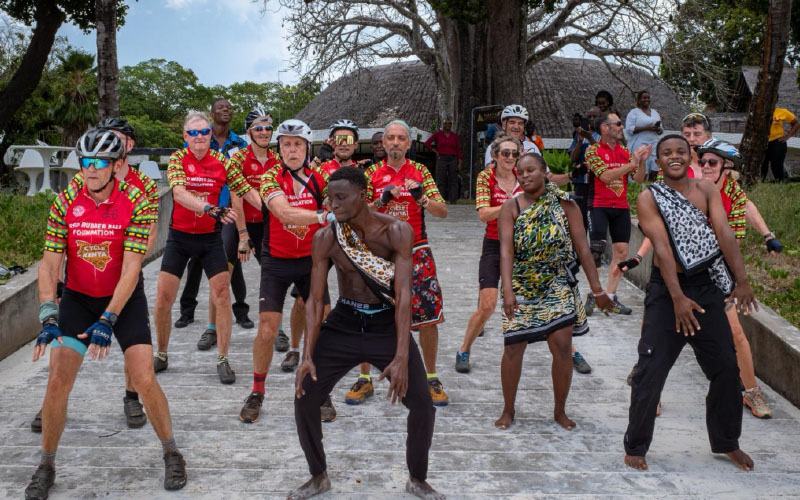
As if cycling the 480-odd kilometres from Nairobi to Mombasa in heat often beyond 30 degrees, wasn’t enough, climate change also threatened to complicate matters. The Kenyan Meteorological Department forecast began highlighting that El Nino effects might be significant in November and December 2026. Indeed, so significant that they predicted the worst rain and flooding for seventy years.
We had several options:
Cancel – though flights and accommodation had already been booked, holidays taken, and as the rain hadn’t actually started, there was no chance of any payout on travel insurance.
Move – to return to Mount Kenya region where we had cycled successfully in 2019 or further to the north. This was possible but offered no greater guarantee that the weather would be any better.
Re-route – to minimise disruption should the rains be as heavy as forecast. This would mean more time on tarmac and some transfers in vehicles between sections affected.
We chose the latter and crossed our fingers. The ride was on.
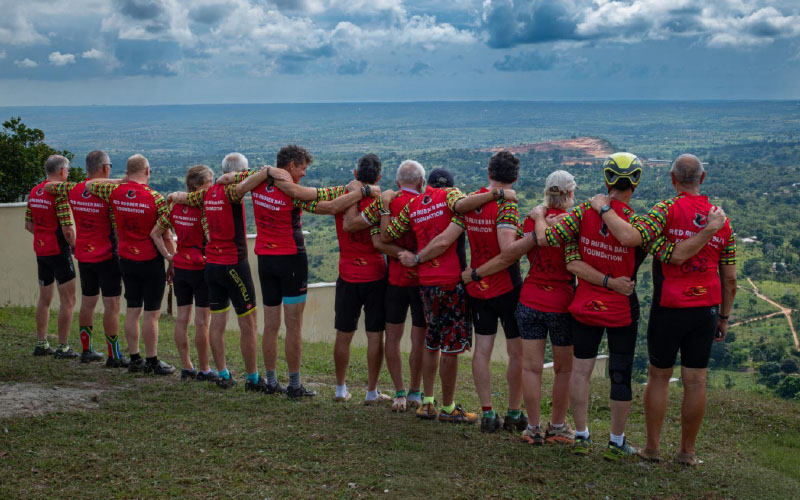
The real challenge was just beginning for our riders
Our first day was a chance to recover from the 9-hour flight, rest and acclimatise in Nairobi at 1,795 feet above sea level, where breathing is already affected when doing any physical activity. Instead we took the group to visit the nearby Kibera slums, home to well over one million people and several projects that we are involved with like St Juliets Primary School. We rather interrupted a holiday programme with the children who attend the school, but came away having seen the very limited school facilities and even learned some basic Swahili.
From there we walked along the old railway line (still used for goods traffic) to Project Elimu, the dance centre run by Mike Wamaya. The children were practicing and shared routines with a folk dance group from Poznan in Poland, visiting for a festival in Nairobi. It was amazing to see how quickly the children picked up new dance moves and performed seamlessly alongside their visitors.
And from there we met up with Kevin, an RRBF alumni, who has his own art stall. Kevin was actually in his overalls doing some very fine detail spray paint graphics on a motor bike. This is just one of the means he generates income from his art along with more traditional paintings, murals and t-shirts.
This all allowed our group to appreciate the challenges locals face living and going to school in slum areas, experiencing the open sewers and cramped living conditions for themselves. Above all they witnessed the joyous spirit in Kibera. Despite the tough conditions, people go about their daily life with resilience, good humour and with a tremendous sense of community.
Of course, we all got to go back to our hotel afterwards. The locals can’t escape so easily. It certainly brought home just why our RRBF scholarships are so important.
Going north to go south
Despite the fact that Mombasa is south of Nairobi, we began our ride by heading north. This seemed curious and left several people questioning their Garmin navigators.
The reason was two-fold – firstly to visit the new Safari Simbaz camp, where their group of riders will be based. We have worked with the Simbaz since 2014 and they are critical to our school cycling clubs. Kinjah (who mentored Chris Froome, when he was a young boy riding the Nairobi hills) identifies each new school and visits to provide instruction and inspiration.
The second reason was to ride ‘The Climb’. This is a route in the Ngong Hills that Kinjah and Chris would often cover on training rides. It became the title of Chris’s autobiography which had been given to each of our riders by the Safari Simbaz. It meant a tough first full day of riding, on tarmac and off-road, 83km including 2700 feet of climbing, interrupted only by a lunch of peanut butter and honey sandwiches and, a first for most of us, tree tomatoes.
It was brutal. But we made it. Though Kinjah missed several of the group at the summit of the climb as they began a speedy decent. We were actually taking another route down. So Kinjah set off in pursuit, catching Matt and Marcel, who rode back to the top, while Alan and David were finally picked up down in the next village and returned to the top by taxi.
Day Two was a ride to the gates of Amboseli Game Park, which turned out to be 20km of tarmac followed by 50km of track. When I say track … this was like riding on corrugated sheets. The red dust becomes rutted by a combination of the heavy rains and heavy safari jeeps. The result is hard, compacted bumps – for mile after mile. We’d initially ride in the ‘gutter’ at the edge of the track, looking for a relatively smooth surface. But even this quickly disappeared. It was like using a jack-hammer on concrete, constantly shaking your hands to ease the vibration.
And the bikes took a battering too. Between the thirteen riders and three Simbaz, we had seventeen punctures on that section of road alone. We ran out of available innertubes. As tubes punctured, the bike went into the following truck and the rider into the bus. If anything, the bus went even slower than the riders as it navigated the bumps.
As the riders on the road became fewer and fewer they encountered a thunderstorm until there were only two left peddling. Finally Andy’s bike broke a hundred meters or so from the end, so he ran, pushing his bike to the gate of Amboseli Game Park, leaving Matt as the only one to ride to the end. Quite a day.
It also meant that Kinjah (the Black Lion) and Mabut (aged just sixteen) would spend the night fixing punctures. The tubes were literally a patchwork of repairs.
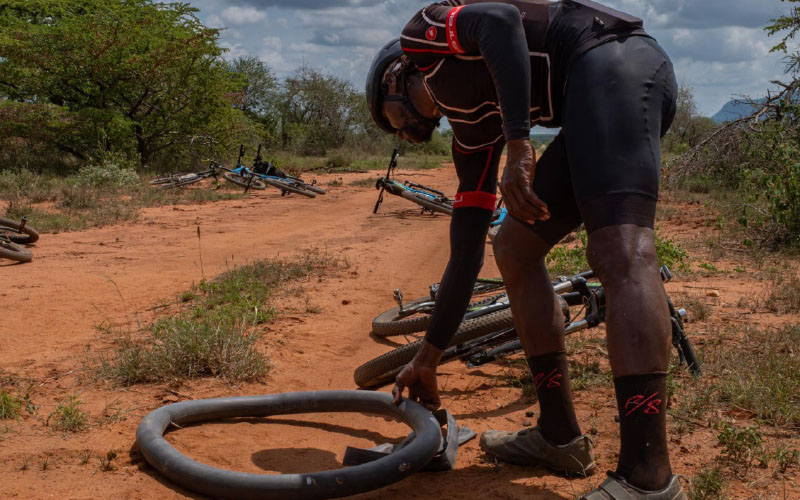
Ironically it was the only significant rain we had. We had changed the route just a few weeks before we set out, fearing the effects of the predicted El Nino. This had some consequences which made the journey more difficult. For one, it lengthened the ride, meaning more time on hot tarmac and several long transfers to connect up the route. It was certainly not ideal, and added to the overall challenge.
And the weather was mostly very hot. Finding shade was a priority whenever we had a stop, and not always possible when waiting at the side of a road with a puncture. Waiting became a theme of the ride. Sometimes to get tubes replaced, sometimes for other mechanical issues (brakes, gears, bearings), and sometimes no-one quite knew why we were waiting. But we waited. Like all good Kenyans.
We came to describe our route in KM i.e. Kinjah metres. These are a unique unit of measurement unconnected to the traditional kilometre, with a seemingly variable and random element. It did mean that you never quite knew exactly how far you had still to ride.
Day Three began with a game drive in Amboseli, a wide, flat game reserve looking out to Kilimanjaro. The group got to see some of the Big Five, as well as hyena, pelicans, flamingos, and a python. I think we were all secretly pleased not to be cycling.
But we left the park gate on our bikes after overcoming the fearsome obstacle of elderly Maasai women selling traditional crafts. They are very persuasive and persistent. I think Kris may be still there now buying bracelets.
Our cycling was a day of around 35km on road and a further 20km of track, interrupted by a game of football with local children during our break for lunch. Our weary riders performed admirably, achieving a 2-2 draw with a bunch of five year olds. The game ended quickly for cycling to resume as soon as their older brothers and sisters arrived. We knew when our time was up.
Day Four was all tarmac. It began with an encounter with a local woman on a rather rickety bike, probably no gears, possibly no brakes. Rusty and workmanlike. But having passed her on our light-weight multi-geared mountain bikes, Kinjah gave her a push and she delighted as she peddled furiously to pass us, smiles all around,
Pretty straight, for around 50km, as we passed through small towns and stalls on the side of the road. Up and down a switchback through the nearby hills. For some this was a joy – a chance to get in some good miles on smooth surfaces. For others torture – sheer monotony in burning heat.
After that a four-hour transfer, slowly making our way along rough tracks to the Kivuli Camp, a secluded eco-camp within the Rukinga Wildlife Conservancy. This is a 74,000 acre corridor between the Tsavo East & West national parks. It is also a woodland habitat for elephants, lions, giraffes, buffalos, and many other wild animal species.
It was the most peaceful place, with just one road in. We were told to store any of our spare food (energy bars etc) in the freezer – with the honesty bar beer – to keep the mice and monkeys away. We had a brief hour of daylight to enjoy the surroundings before a delicious dinner eaten in the open air.
Day Five meant riding out from the camp, which promised a further adventure. As a private conservancy there were no restrictions from the Kenya Wildlife Service on cycling, but we were informed by the camp staff that they had reports of elephants in the area. As you can imagine, elephants are not to be messed with, so we started the day in the bus until we got past the area where the elephants were thought to be.
This turned out to be near a waterhole where we found one elephant stuck on its side in the mud. It appeared that the others had been there that night with just this one remaining, struggling to free itself. It was clearly exhausted. It was a distressing sight; one a group of cyclists were ill-equipped to do much about. A call went in to the camp and we heard later that the KWS had managed to free the stranded elephant, though it was not in good shape.
This was the circle of life in front of us, not the Disney version.
As we settled into our ride out of the conservancy, looking out for animals in the bush on both sides, our route took several mis-turns. We were being led by Kinjah, our cycling guide; Emmanuel, a local mountain guide; and finally a local villager on a motorbike, who finally found a path to the main road. We made it, in a roundabout fashion.
As if bumps are not enough on the uneven tracks, here we encountered sand. We would be riding along then suddenly hit thick sand, throwing you off (literally in some cases) course. There were places where we had to get off and push. Neil fell into a thorn bush and with several others had falls or near-misses along the way.
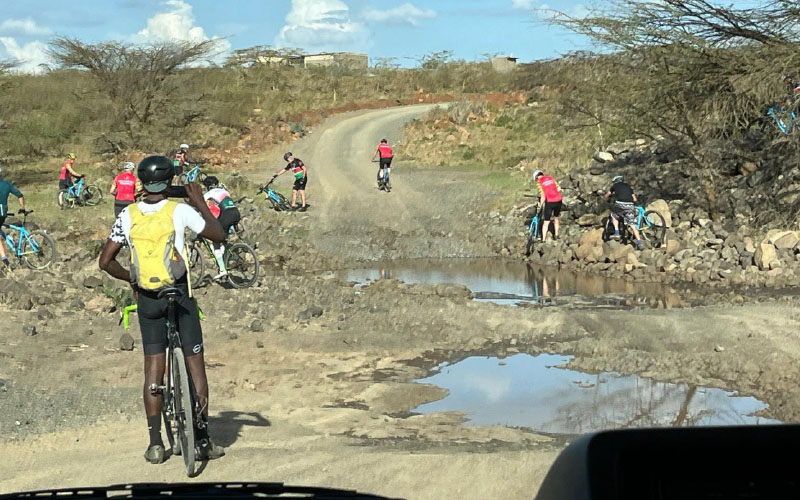
But the slower pace and uncertain terrain meant that we stayed closer together as a group and being together in this unique environment was a special moment. We had no idea where we were or where we were going, but we were lost together.
After 50km all on tracks, we were all delighted when we reached our accommodation for the night and found that each room had a spa bath. What a welcome relief.
The spa baths didn’t work! They say it’s the hope that kills you. Oh, the anticipation. And oh, the disappointment. At least most of us had a trickle of (cold) water – Matt didn’t have any. He described having a ‘dry towel wash’. All part of the experience, though not one we’d planned. Thank you Matt for taking it in good spirits.
And so all too quickly we were at Day Six, our final ride to the coast and the Indian Ocean at Diani Beach, around 30km south of Mombasa.
The last day was a shorter day to allow time for our welcome and a little relaxation at the beach. We had around 45km of road and a little track, with the group again riding all together.
We fished with the last 100 metres or so actually riding along the beach to our final destination, before being greeted by the hotel staff singing and dancing. And of course, we went straight into the lovely warm sea – most of us remembering to take our phones out of our pockets first.
Journey complete.
Challenge met. Distance, heat, bumps, diversions, tarmac, transfers, long waits, curious food, sometimes lacking facilities … and at the same time, beautiful scenery, lovely people, singing, dancing, even football, new friends, and amazing spirit.
All part of cycling in Kenya.
And the joy of doing a challenge together. A common purpose, open to new adventure, willing to experience a new culture, bringing good humour in adversity, patience overcoming frustration, and helping anyone who needed help. Thank you all.